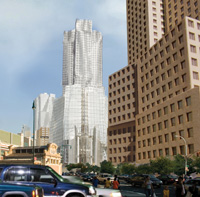
 The Fort Greene Association has been deeply involved with the course of events regarding the Atlantic Yards. In case you missed it, these are two important articles from the New York Times on March 21.
Slow Economy Likely to Stall Atlantic Yards
By CHARLES V. BAGLI
Published: New York Times, March 21, 2008
The slowing economy, weighed down by a widening credit crisis, is likely to delay the signature office tower and three residential buildings at the heart of the $4 billion Atlantic Yards project in Brooklyn, the developer said…. Read the entire NYT article here.
What Will Be Left of Gehry’s Vision for Brooklyn?
By NICOLAI OUROUSSOFF
Published: New York Times, March 21, 2008
The growing possibility that much of the multibillion-dollar Atlantic Yards development in Brooklyn will be scrapped because of a lack of financing may be a bitter pill for its developer, Forest City Ratner. But it’s also a painful setback for urban planning in New York.
Designed by Frank Gehry, the project was a rare instance in which the architectural talent lined up for a New York project matched the financial muscle behind it. When it was unveiled in late 2003, it seemed to signal a genuine effort to raise the quality of large-scale development in a city still stinging from the planning failures at ground zero.
So if the decision to proceed with an 18,000-seat basketball arena but to defer or eliminate the four surrounding towers is defensible from a business perspective, it also feels like a betrayal of the public trust.
Mr. Gehry conceived of this bold ensemble of buildings as a self-contained composition — an urban Gesamtkunstwerk — not as a collection of independent structures. Postpone the towers and expose the stadium, and it becomes a piece of urban blight — a black hole at a crucial crossroads of the city’s physical history. If this is what we’re ultimately left with, it will only confirm our darkest suspicions about the cynical calculations underlying New York real estate deals.
The project that the city approved in late 2006 would have included eight million square feet of residential and commercial development on an eight-acre site extending east from Flatbush and Atlantic Avenues, one of the borough’s most congested intersections. For many who opposed it early on, it was yet another instance of powerful economic interests trampling on the rights of a deeply rooted middle-class community - one that had already been reshaped by waves of transplanted Manhattanites. Mr. Gehry’s involvement was simply a bit of window dressing intended to give the project an aura of enlightenment.
I sympathized with these arguments to some degree. New York has had a terrible track record with large-scale planning in recent years. Look at Battery Park City. The MetroTech Center. Donald Trump’s Riverside South. All are blots on the urban environment, as blandly homogenous in their own way as the Modernist superblocks they were intended to improve on.
But it’s important to remember that this is also the city that spawned Rockefeller Center, a 22-acre development at the core of Manhattan that became a glorious emblem of the 20th-century metropolis. For some of us Atlantic Yards presented a creative opportunity for the 21st century.
If large-scale development is unavoidable, why not enlist serious talents like Mr. Gehry to come up with an alternative to the bottom-line proposals that have been the accepted norm for decades? Finally a big developer had turned to a legitimate architectural hero for help, rather than the usual corporate hacks.
As it turned out, Mr. Gehry’s design revealed both the promise and the limits of that collaboration. The main residential blocks to the east of the arena lacked the architect’s signature ebullience. A series of mismatched towers along two sides of a central courtyard encompassing several blocks, they followed most of the usual planning rules: adhere to the street grid, pack in a good deal of retail along the street, add a dose of public space. …Read the entire NYT article here.
No development at all would be preferable to building the design that is now on the table. What’s maddening is how few options opponents seem to have.
Expect a full update on the status of the Atlantic Yards at our next general meeting April 28, 2008.