 |
|
 |
|
|
Admiral's Row Fort Greene Association warns of imminent |
||
The Greene Grape is proud to underwrite the November 2006 issue of the Fort Greene Association Newsletter.

Ft. Greene, Brooklyn 765 Fulton Street T 718.797.9463 The Fort Greene Association Website Sponsored by, |
|||
 |
|||
 |
|||
 |
|||
 |
|||
 |
|||
 |
|||
|
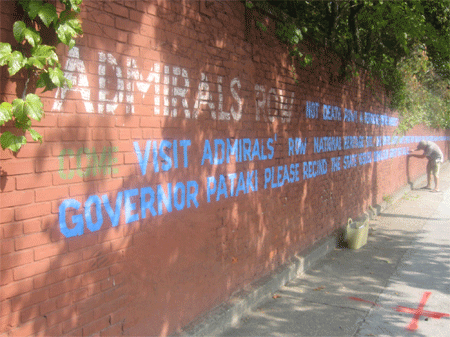
Help Save Admiral's Row
Photo credit D.K. Holland Coalition Steps Up Effort Industrial Park Wants To Demolish Them When It Takes Title to Land Meanwhile, the word from Eric Deutsch, president of the Brooklyn Navy Yard industrial park, which occupies most of the former U.S. Navy installation, is that the long-unused houses are so far gone that they can’t be saved. Indeed, he said, any attempt to replicate them would make it unfeasible for new commercial and industrial businesses to come to this section of the Navy Yard. What’s making this issue urgent in the eyes of the preservationists, who have banded together under the aegis of the Admiral’s Row Coalition, is the fact that the U.S. Army Corps of Engineers, which owns the houses and surrounding land, has agreed to transfer property rights to the city. The city would then, according to Deutsch, lease the property to the Navy Yard industrial park. This must go through the city’s ULURP (Uniform Land Use Review Process), and the City Council is expected to decide on the matter by the end of the month. Some of the many members of the coalition include the Historic Districts Council, New York Landmarks Conservancy, Fort Greene Association, Pratt Institute, Brooklyn Heights Association, Boerum Hill Association and others. Paul Palazzo, of the Fort Greene Association, acknowledges that the houses, some of which date back to the Civil War, are in “terrible shape especially the wooden extensions,” and questions a survey the Navy Yard industrial park took about 10 years ago that concluded that they are beyond repair. The coalition, he says, recently commissioned a new engineering survey by Robert Silman Associates that concluded that “six of the masonry brick buildings are salvageable,” although the buildings’ wood additions and decks, and other buildings that are completely made of wood, are not. Commenting on reports that a “big box” store was envisioned for the site, Palazzo said, “I spoke to the Farragut Houses tenants’ association. They said they don’t want a box store; what they do want are smaller stores like dry cleaners, day care centers, job training facilities.” These, he said, are the types of uses that could be situated in the refurbished old officers’ houses. “The point is,” he said, “that this is a piece of Brooklyn history. Brooklynites feel attached to this for a good reason, because of the Brooklyn effort during World War II,” when the Navy Yard was building ships day and night. ‘Not Barracks — Mansions’ “These homes were once an important part of the social life of the Navy Yard,” he said. “These were not barracks — they were mansions.” Simeon Bankoff, executive director of the Historic Districts Council, said that instead of having the city hand the property off to the Navy Yard, the city should “mothball” or weatherproof the houses, then issue an RFP for development ideas. “These houses are very much worthy of being preserved,” he said, saying they were built in the “Second Empire Style.” By contrast, he said, the officers’ houses on Governors Island are “simpler, plainer.” Deutsch of the Navy Yard said that the yard plans “to redevelop the site to create more industrial and retail jobs. We would like to use part of the site for more industrial space, and some of the frontage along Flushing Avenue for retail.” He stressed that the Navy Yard has spent many thousands of dollars and many man-hours inspecting the Admiral’s Row area, and that if the houses were rebuilt, “we would be replicating, not preserving, them — I’ve gone to some of those houses, and then gone back a few weeks later, and the part that I’d been standing in had collapsed.” Deutsch said the Navy Yard is committed to historic preservation. “We do use a number of 19th century buildings today, and spent several hundred thousands of our own money to rehabilitate the old Navy Hospital and Surgeon’s House, which we only got back [from the federal government] about five years ago. But those were buildings that could be preserved.” Deutsch and his critics do agree on one thing: that the federal government has been a terrible guardian of the site, allowing the buildings’ condition to go from bad to worse. After the U.S. Navy closed the original Navy Yard in the mid-1960s, it continued to house some personnel in the officers’ houses until the mid-1970s, but afterward transferred ownership of the site to the Army Corps of Engineers. © Brooklyn Daily Eagle 2005 ******PRESS RELEASE IMMEDIATE RELEASE****** A growing coalition of concerned community organizations including the Historic Districts Council, New York Landmarks Conservancy, Pratt Institute, Myrtle Avenue Brooklyn Partnership, Brooklyn Heights Association, Metropolitan Waterfront Alliance, Boerum Hill Association, The Society for Clinton Hill, New York Preservation Alliance, Farragut Tenants Association, Walt Whitman Houses, Carlton Willoughby Block Association, Municipal Art Society, Vanderbilt Avenue Block Association, and The Historic Wallabout Association have joined voices with the Fort Greene Association to form the Admiral’s Row Coalition. Together the Coalition is requesting that the City Council and Mayor Michael Bloomberg place a moratorium on the demolition of Admiral’s Row located at the Brooklyn Navy Yard. Information released in a recently performed survey of the historic site by noted engineering firm, Robert Silman Associates states “that six of the residential masonry brick buildings are salvageable” has redoubled the efforts of preservationists and developers to halt the demolition of this public asset. The Coalition is requesting that the site be “mothballed” to prevent any further deterioration of the site and in addition a request for proposal be issued for adaptive reuse redevelopment. Redevelopment of the historic asset should be advised by the Coalition with strong attention to the needed community services and quality of life requirements of the surrounding residents of the Farragut, Whitman, and Ingersoll Houses while acknowledging the historic significance of the site located at the Brooklyn Navy Yard. Paul Palazzo a member of the Fort Greene Association and member of the Coalition states that “mothballing Admiral’s Row now is a low cost solution that will allow the City, the market sector, and the surrounding neighborhoods to make an accurate appraisal of Admiral’s Row. Bringing Admiral’s Row to the open market with guidance from the community will be a win for jobs, a win for the needs of the local residents, and a win for the recognition of the monumental effort and sacrifice made by New Yorkers at this location.” The Coalition also requests that the City Council alter the proposed ULURP application and bisect the land parcel as to not interfere with the imminent plans of the Brooklyn Navy Yard Development Corporation to construct light manufacturing buildings on the land not containing the historic structures. The City Council is expected to vote on the transfer of property by the end of October. “What I really don’t want to see is a grocery store. What we need are other services in this community” – Mary Andrews, Farragut Tenants Association “ We should not rush to destroy Admiral’s Row. We may be throwing away a huge economic benefit and cultural treasure for the local community and the City of New York. – Paul Palazzo, Admiral’s Row Coalition. For further information please contact Download this October 7 press release Help the FGA save Admiral's Row. Write a letter to the following elected officials today. The Demolition could be as soon as the end of October. Councilmember Melinda Katz
Councilmemeber David Yassky
Council Speaker Gifford Miller
Councilmember Letitia James
Mayor Michael R. Bloomberg
E-BULLETIN OF THE HISTORIC DISTRICTS COUNCIL October 2005, Volume 2 Number 10 19th Century Admirals’ Row Houses To Be Demolished For Supermarket! The Officer’s Quarters along Flushing Avenue in the Brooklyn Navy Yard have long been unprotected landmarks in need. Originally built around the time of the Civil War for officers and their families, this row of French Empire style masonry and wood buildings (also called Admiral’s Row) have been vacant since the 1970’s. They are part of a six-acre site that is the process of being given over to the Brooklyn Navy Yard Development Corporation for new industrial development. The houses themselves have long been neglected, and two of them have sustained recent fire damage (there are six in total). The BNYDC has proposed to demolish the buildings and develop a supermarket on the site, citing job development concerns and the creation of a community amenity. While the development corporation has been, for the most part, a responsible steward for the numerous historic properties under their stewardship, HDC – joined by a coalition of community groups that neighbor the Navy Yard – strenuously objects to the demolition of the historic buildings and is disappointed in the development corporation’s lack of vision. The Advocate for New York City’s Historic Neighborhoods 1.Join the FGA Landmarks Committee 2.Write a letter to the current owners of the property the US Federal Government Senator Charles E. Schumer 3. Testify at the scheduled ULURP hearing at: For agenda and speaking form visit http://nyc.gov/html/dcp/pdf/luproc/calendar.pdf Admiral's Row visual tour August 4, 2005. Views of Officer’s Quarters in the Brooklyn Navy Yard.     
Exterior walls, note that windows have been covered with Lexan to prevent further water penetration.
Interior of one of the buildings. Interior walls are stable, as are the majority of floors.
Interior of one of the buildings. Note stability of hearth
Another interior. Again, walls & floor appear stable.
Two views of interior staircases. Again, stairs and masonry walls appear to be stable.
        ******PRESS RELEASE****** August 24, 2005 The buildings which are currently owned by the US Army Corps of Engineers have been seriously neglected and are to be discharged to the City of New York. Upon completion of this transaction the Brooklyn Navy Yard Corporation [BNYDC] plans to demolish the historic structures to make way for a single cinder block store. Paul Palazzo representing the FGA Landmarks Action Committee stated “While the BNYDC sees the short term economic gain in replacing Admiral’s Row with a large retail operation it does so while ignoring and undermining the historic base that has proven to be the bedrock of the neighborhood.” Mr. Palazzo continued saying “My predecessors in the Fort Greene Association understood this bedrock when in 1973 they began the process to recognize the historic value of the neighborhood. These early efforts were met with skepticism which often pitted historic preservation against economic development. Thirty-two years later, although the arguments remain the same, we can all recognize that historic preservation and economic development are not on opposing sides but work hand in hand to amplify each other. Today, Fort Greene, once red-lined and maligned as blighted is now an engine pumping life into adjacent neighborhoods with their own historic pride and economic possibilities for their own futures. The same is true for the Admiral’s Row site.” Also testifying was Simeon Bankoff of The Historic Districts Council [HDC] who agrees with the FGA on its position of adaptive reuse and has urged BNYDC stating “Today, seven of the ten Admiral’s Row houses. Which were built between 1864 and 1901, still remain. While in declining condition, they certainly could be restored and serve as vital components, both historically and practically for this neighborhood. They could be easily incorporated into the Navy Yard plans and provide much needed retail or commercial spaces for the community.” Previously the FGA has asked the BNYDC to consider the opportunity in the preservation of Admiral’s Row by adaptively reusing the buildings and to open the site to an RFP [Request for Proposal]. Through its own outreach the FGA has received many calls from interested commercial developers but the BNYDC response to an open market solution has been negative and dismissive. “We (the FGA) are perplexed as to why BNYDC would choose to throw away this economic opportunity, with zero cost to the City of New York, and waste the monumental economic and cultural potential waiting to be reaped from this historic asset.” – Paul Palazzo FGA Landmarks Action Committee For further information please contact the Fort Greene Association download pdf of this August 24 press release Dear Commissioner Burden, Thank you for allowing me to speak before you today. I am not an historian, nor an economist, but a resident of Fort Greene, Brooklyn which like all of New York has seen highs and lows, economic booms and busts. Through the down times Fort Greene’s sense of its own history has stabilized it and that same sense of history has propelled it farther than anyone could imagine; Fort Greene’s future is inextricably linked to its history. Today we are presented with an opportunity for Fort Greene both economically and culturally. The neglected historic structures known as Admiral’s Row are to be transferred the City of New York and then leased to the BNYDC as steward of this historic asset. The new stewards of Admiral’s Row have made it clear that they will promptly destroy the structures to make way for what they see as an economic opportunity in the form of a large scale single vendor retail space. While the BNYDC sees the short term economic gain in replacing Admiral’s Row with a large retail operation it does so while ignoring and undermining the historic base that has proven to be the bedrock of the neighborhood. My predecessors in the Fort Greene Association understood this bedrock when in 1973 they began the process to recognize the historic value of the neighborhood. These early efforts were met with skepticism which often pitted historic preservation against economic development. Thirty-two years later, although the arguments remain the same, we can all recognize that historic preservation and economic development are not on opposing sides but work hand in hand to amplify each other. Today, Fort Greene, once red-lined and maligned as blighted is now an engine pumping life into adjacent neighborhoods with their own historic pride and economic possibilities for their own futures. The same is true for the Admiral’s Row site. It is to this end that the Fort Greene Association has kindly asked the BNYDC to consider the opportunity here in the preservation of Admiral’s Row by adaptively reusing the buildings to both serve the immediate needs of the surrounding community while recognizing its historic past. We have asked that the BNYDC open the site to an RFP with the caveat of preservation. While the FGA outreach to commercial developers has been exciting, the BNYDC response to this open market solution has been negative and dismissive. The Fort Greene Association is perplexed as to why BNYDC would choose to throw away this economic opportunity, with zero cost to the City of New York, and waste the monumental economic and cultural potential waiting to be reaped from this historic asset. While the ULURP application as written does not detail the destruction of Admiral’s Row allowing the application to proceed unaltered is a defacto approval of their demolition. The Fort Greene Association kindly asks that the City Planning Commission alter the terms of this ULURP application to include the historic preservation of Admiral’s Row as to recognize their local and national historic and economic value, and the sacrifice thousands have made at the Brooklyn Navy Yard in service to our country; in doing so this Commission will have built a strong historic foundation which will lead to the economic revitalization of this area of Fort Greene. Sincerely, Paul Palazzo download pdf of letter to Commissioner Burden News 12 Brooklyn News: News12.com Navy Yard Admiral’s Row: by Sarah Ryley ([email protected]), July 26, 2005 The Fort Greene Association [FGA] warns the com- According to Paul Palazzo, chair of the FGA Landmarks Action Simeon Bankoff of The Historic Districts Council [HDC] agrees The FGA asks BNYDC to reconsider their inflexible position as “One thing is certain, once these building are destroyed so will be a –Paul Palazzo, FGA For further information please contact download pdf of this July 26 press release |
||
|
Box 170563, Brooklyn, NY 11217-0563
Tel. 718.875.1855 |
|